
A chicken patty gets substituted mid-year. A recipe changes. An allergy-safe ingredient comes into contact with a shared utensil or prep surface. These may seem like small changes, but they matter when you’re serving a student with a food allergy.
Managing food allergies in school nutrition programs touches nearly every part of the meal process. Teams need to know what’s in the products they’re using and keep allergen information current when ingredients change. They also need to prevent cross-contact, train staff, and plan special diet meals.
Food allergy training is also becoming an even bigger part of the work. The Whole Milk for Healthy Kids Act of 2025, signed into law in January 2026, added food allergies to federal training requirements for local school food service personnel.
The goal is to keep students safe while making sure those with food allergies feel included at mealtime. Clear procedures and thoughtful planning can help teams manage food allergies throughout the school year.
What Are the Most Common Food Allergens?
The Big 9 are the major food allergens that federal law requires manufacturers to identify on product labels. They account for the majority of serious allergic reactions in the U.S., but they are not the only allergens students may have.
School nutrition teams should check labels against any other allergies noted in individual students’ dietary or medical documentation.
According to the Centers for Disease Control and Prevention (CDC), about 1 in 13 children (8%) in the United States has a food allergy.
The Big 9 allergens must be identified on applicable packaged food labels, which helps school nutrition teams know what to look for when reviewing products and ingredients.
What is the Difference Between a Food Allergy and a Food Intolerance?
The main difference between a food allergy and a food intolerance is how the body reacts. A food allergy involves the immune system, while a food intolerance typically affects digestion.
- Food Allergy: An immune system reaction that can occur even after eating a small amount of an allergen. Symptoms may include hives, swelling, nausea, vomiting, difficulty breathing, or a severe, potentially life-threatening reaction called anaphylaxis.
- Food Intolerance: A reaction that generally involves the digestive system and may cause symptoms such as bloating, stomach pain, or diarrhea. Unlike food allergies, food intolerances do not typically cause anaphylaxis.
For school nutrition teams, understanding this difference is important when planning meals and accommodating students’ dietary needs.
Food allergies require particular attention because even small amounts of an allergen can cause serious reactions in some students. Reviewing ingredients, preventing cross-contact, and following consistent food preparation procedures can help keep students safe.
When Should Allergens Be Identified During Menu Planning?
School nutrition departments should identify allergens when reviewing recipes, ingredients, and product labels during menu planning. This helps teams understand which allergens are present before meals are prepared and served to students.
It’s important to review the specific products being used, not just the type of food. For example, a breaded chicken patty from one manufacturer may contain different allergens than a similar product from another manufacturer.
Vendor substitutions and product reformulations can happen at any time, so allergen reviews should be ongoing, particularly when a district has been notified of a change.
When a product changes, teams should review the current ingredient label, confirm whether the new product is appropriate for students with food allergies, and update their menu planning information as needed.
If your district learns about a manufacturer reformulation, let the Health-e Pro team know, too! Sharing these updates can help us review product information and keep our database as current as possible.
How Can You Create Special Diet Menus That Students Enjoy?
Creating special diet menus students enjoy starts with thoughtful planning, safe substitutions, and finding ways to keep meals similar to what’s being served on the regular menu.
A student with a wheat allergy shouldn’t have to miss out on taco day. With a few thoughtful substitutions, they can enjoy a meal that’s similar to what their classmates are eating.
Special diet menus need to keep students safe, but they should also help students feel included at mealtime.
One way to make that easier is to build a cycle menu for special diets, just like you would for the regular menu. Planning ahead gives students more variety and helps teams avoid coming up with substitutions meal by meal.
When possible, try to keep special diet meals close to what’s being served on the regular menu. An allergy-safe version of the same meal can help students feel included without requiring an entirely different entrée.
Darcy Burt, Health-e Pro’s Principal Customer Success Manager and Registered Dietitian, shared how she approaches special diet menu planning when working with school nutrition districts:
“I tried to make the allergen menu as close to the regular menu as possible so that kids don’t feel excluded. If it’s chicken tenders on the menu, I’m doing gluten-free chicken tenders. That’s been a really big push with most of my districts.” – Darcy Burt, RDN, Health-e Pro Principal Customer Success Manager
The same approach can work for other menu favorites. For example, if a student has a wheat allergy, the special diet menu can stay very close to the regular menu:
- Main Entrée: Bang Bang Breaded Chicken Tacos on Flour Tortillas
- Wheat-Free Entrée: Bang Bang Grilled Chicken Tacos on Wheat-Free Corn Tortillas
The main entrée contains wheat in both the breaded chicken bites and flour tortillas. By swapping the breaded chicken for grilled chicken chunks and using wheat-free corn tortillas, the team can offer a similar meal that accommodates the student’s allergy.
These substitutions also allow the team to plan for meal pattern requirements.
- The main entrée credits for 2 ounce equivalents of Meat/Meat Alternates and 3 ounce equivalents of Grains.
- The wheat-free entrée credits for 2 ounce equivalents of Meat/Meat Alternates and 2 ounce equivalents of Grains.
Since the grain contributions are different, teams should verify that the complete special diet meal meets applicable meal pattern requirements.
It’s also important to review product labels and ingredients and follow procedures to prevent allergen cross-contact during preparation and service.
The same approach applies to holidays, celebrations, and themed meals. These are often some of the most exciting days in the cafeteria, and students with food allergies should have opportunities to participate, too.
A little extra planning can help give students with food allergies more variety while making special diet menus easier for school nutrition teams to manage.
What’s the Difference Between Cross-Contact and Cross-Contamination?
Cross-contact and cross-contamination are often used interchangeably, but they describe different food safety risks. The key difference is what’s being transferred to the food and how that risk can be addressed.
Cross-contact happens when an allergen protein is unintentionally transferred from one food or surface to another. For example, using the same tongs for breaded chicken containing wheat and grilled chicken being prepared for a student with a wheat allergy.
Cross-contamination typically refers to the spread of harmful bacteria or other microorganisms from one food or surface to another. For example, cutting raw chicken on a cutting board and then using the same board to cut vegetables without properly cleaning and sanitizing it.
One important difference is how these risks are handled. Cooking food to the proper internal temperature can kill many harmful bacteria, but cooking does not reliably eliminate food allergens.
That means a chicken entrée could be fully cooked and safe from harmful bacteria, but still unsafe for a student with a wheat allergy if wheat proteins came into contact with it during preparation.
Cleaning procedures matter, too. While sanitizing helps reduce harmful microorganisms, sanitizing alone may not remove allergen proteins. Utensils, equipment, and preparation surfaces need to be thoroughly washed with soap and water, rinsed, and sanitized according to established procedures. Using separate equipment and utensils can also help prevent allergen cross-contact.
Understanding this difference is important because even when a recipe doesn’t contain a student’s allergen, the way that meal is prepared and served can introduce additional risks.
How Can School Kitchens Prevent Cross-Contact?
Preventing allergen cross-contact starts with consistent procedures for handling ingredients, preparing meals, and serving students with food allergies.
Before preparing a special diet meal, staff should wash their hands with soap and water, change gloves, and make sure preparation surfaces, utensils, and equipment have been thoroughly cleaned. Food-contact surfaces and equipment should be washed, rinsed, and sanitized according to established procedures. Separate utensils and equipment can also help reduce the risk of accidental allergen transfer.
Ingredient storage and handling matter, too. A shared scoop in a bulk ingredient container or a cutting board used earlier in meal preparation could introduce an allergen into a meal that otherwise contains approved ingredients.
It’s also important to think about what happens after the meal is prepared. Shared serving utensils, crowded serving areas, or mix-ups during meal distribution can create opportunities for cross-contact.
Clear communication between kitchen and serving staff helps ensure special diet meals are handled appropriately and reach the correct students.
These steps are easier to follow when they’re part of the kitchen’s everyday procedures rather than something staff have to figure out during a busy meal service.
Including cross-contact prevention in staff training and standard operating procedures (SOPs) can help everyone understand how to prepare and serve meals safely.
How Can School Nutrition Teams Safely Serve Students With Food Allergies?
Safely serving students with food allergies requires more than preparing the right meal. School nutrition teams also need a reliable way to make sure that meal reaches the correct student.
A special diet meal can be prepared correctly in the kitchen, but mistakes can still happen during a busy meal service. Having a consistent process helps reduce that risk.
There are several ways school nutrition teams can make that process more reliable.
Use point-of-sale alerts. If your point-of-sale system allows it, an alert can notify staff that a student has a food allergy or approved meal accommodation when they enter their number or scan their ID. These alerts can serve as an additional reminder, but they shouldn’t replace established meal verification procedures.
Create a routine that works for your cafeteria. That might mean having a student check in with a familiar, trained staff member or establishing a specific process for distributing special diet meals. Consistent routines can help staff follow the correct procedures, even during a busy lunch period.
Verify meals before serving. Staff should have a clear process for confirming that a special diet meal has been prepared according to the student’s approved accommodation and is being given to the correct student. This is especially important when multiple students have different food allergies or dietary needs.
Build relationships with students. When students know the people preparing and serving their meals, they may feel more comfortable asking questions or speaking up if something doesn’t look right.
Keep allergy information current. School nutrition staff should stay in communication with nurses, parents, and other appropriate school staff about students’ food allergies and meal accommodations. If something changes, the people responsible for preparing and serving those meals need to know.
Provide ongoing staff training. Training helps employees understand their responsibilities when preparing and serving meals for students with food allergies. We recommend covering topics such as identifying allergens, preventing cross-contact, following approved special diet procedures, and recognizing and responding to allergic reactions. Regular training also gives staff an opportunity to review procedures and ask questions, especially when processes change or new employees join the team.
Protect student privacy. Staff need the information necessary to serve students safely, but that information should only be shared with those who need it. The serving process shouldn’t unnecessarily draw attention to a student’s medical or dietary needs.
There isn’t one process that works for every cafeteria. A smaller school with a familiar serving line may handle things differently than a large district serving thousands of meals across multiple buildings.
What matters is having a process that staff understand and can follow consistently, including when regular employees are absent or the serving line gets busy.
What Should a School Nutrition Food Allergy SOP Include?
A food allergy Standard Operating Procedure (SOP) outlines how school nutrition teams review ingredients, prevent cross-contact, prepare special diet meals, and serve students with food allergies safely.
Having these steps documented helps staff understand their responsibilities and gives them a resource to reference when questions come up or something changes during meal service.
A school nutrition food allergy SOP should address:
- Product reviews and substitutions: How new products and substitutions are checked for allergens before being added to a menu.
- Special diet menu planning: Who is responsible for approving, updating, and communicating changes to special diet menus.
- Cross-contact prevention: How staff prevent allergens from coming into contact with other foods during storage, preparation, and serving.
- Meal preparation: How approved special diet meals are prepared, identified, and verified before serving.
- Meal service: How staff make sure the correct meal reaches the correct student while protecting student privacy.
- Staff communication: Who employees should contact when they have questions about an ingredient, product substitution, or special diet meal.
- Allergic reaction procedures: What steps staff should follow if a student experiences a suspected allergic reaction, in accordance with the school’s emergency response plan.
- Staff training: How new and existing employees are trained on food allergy procedures and kept informed when those procedures change.
Having a documented process is especially helpful when a product changes unexpectedly, a substitute employee is covering meal service, or a new team member is learning the kitchen’s routines.
An SOP doesn’t replace staff training or communication with families and school nurses. It helps make those efforts more consistent by putting the district’s procedures in one place.
Need help getting started? Use Health-e Pro’s Example Food Allergy SOP in the toolkit below as a starting point for developing or reviewing your district’s procedures.
How Does Health-e Pro Help With Food Allergy Management?
Health-e Pro helps school nutrition teams manage food allergies by keeping recipes, product documentation, and allergen information connected in one place.
When product labels are stored in one location, recipes in another, and allergen information is spread across spreadsheets and emails, finding what you need can take time. That becomes even more challenging when products change or a student needs a special diet menu.
Health-e Pro brings more of that information together, with a library of more than 5,000 recipes and 20,000 products and ingredients, along with available documentation and allergen information.
Daniel Guerra, MA, RDN, Health-e Pro’s Account Executive, previously managed food allergies and special diets at a district in Texas. He knows firsthand how time-consuming it can be to keep ingredient and allergen information updated.
“I wish I’d had Health-e Pro when I managed special diets in my district. Having product documentation and allergen information readily available in one place would have saved me hours of searching for information and entering data when updating my recipes and menus.” – Daniel Guerra, MA, RDN, Health-e Pro Account Executive
Instead of searching through recipes individually, teams can use allergen filters to narrow down options that may meet a student’s dietary needs. This can make it easier to plan special diet menus, find possible substitutions, and offer students more variety.
Health-e Pro’s online menus also allow parents and nurses to filter menu items by allergen. This gives families another way to review what’s being served and can help support conversations about a student’s dietary needs.
Allergen filters are only one part of food allergy management. Product formulations and substitutions can change, so teams still need to verify current ingredient and allergen information, follow approved meal accommodations, and use proper food preparation procedures.
By keeping recipes, product information, documentation, and allergen details more accessible, Health-e Pro helps school nutrition teams spend less time searching for information and more time planning meals that meet students’ needs.
Food Allergy Resources for School Nutrition Programs
You don’t have to build your district’s food allergy procedures from scratch. There are plenty of resources available to help school nutrition teams develop procedures, train staff, and keep students with food allergies safe.
Health-e Pro has put together a Food Allergies Resource Kit with practical tools to help your team get started. The kit includes printable food allergy posters to display in your kitchens, an example food allergy standard operating procedure (SOP) to use as a starting point, and an SOP checklist to help you review your procedures and identify potential gaps.
Fill out the form below to get the Food Allergies Resource Kit to access all three resources in one place.
For additional guidance and training, explore these resources:
- Food Allergies and Special Diets Expert Video: Food allergy education from one of Health-e Pro’s school nutrition experts, Daniel Guerra.
- Managing Food Allergies & Special Diets in School Nutrition Expert Video: Continue learning about food allergies and special diets with Jenna Morris in Part 2 of Health-e Pro’s Expert Series.
- USDA (U.S. Department of Agriculture): Information about the Big 9 allergens and food allergy safety.
- FARE (Food Allergy Research & Education): Food allergy management resources and recommendations for K–12 schools.
- SNA (School Nutrition Association): Food allergy resources, frequently asked questions, and training information for school nutrition professionals.
- FDA (U.S. Food and Drug Administration): Information about major food allergens, labeling requirements, and food allergy safety.
- CDC (Centers for Disease Control and Prevention): Guidance and resources for managing food allergies in school settings.
Managing food allergies takes coordination from menu planning through the last meal served.
When teams have accurate allergen information, clear procedures, and the training they need, they’re better prepared to handle product changes, meal substitutions, and the unexpected situations that come up during the school year.
Most importantly, those efforts help students with food allergies enjoy school meals safely and feel included alongside their classmates.
Get the Food Allergies Resource Kit
Three ready-to-use tools to help your team review its food allergy procedures, train staff, and keep allergy-safe practices front and center in the kitchen.
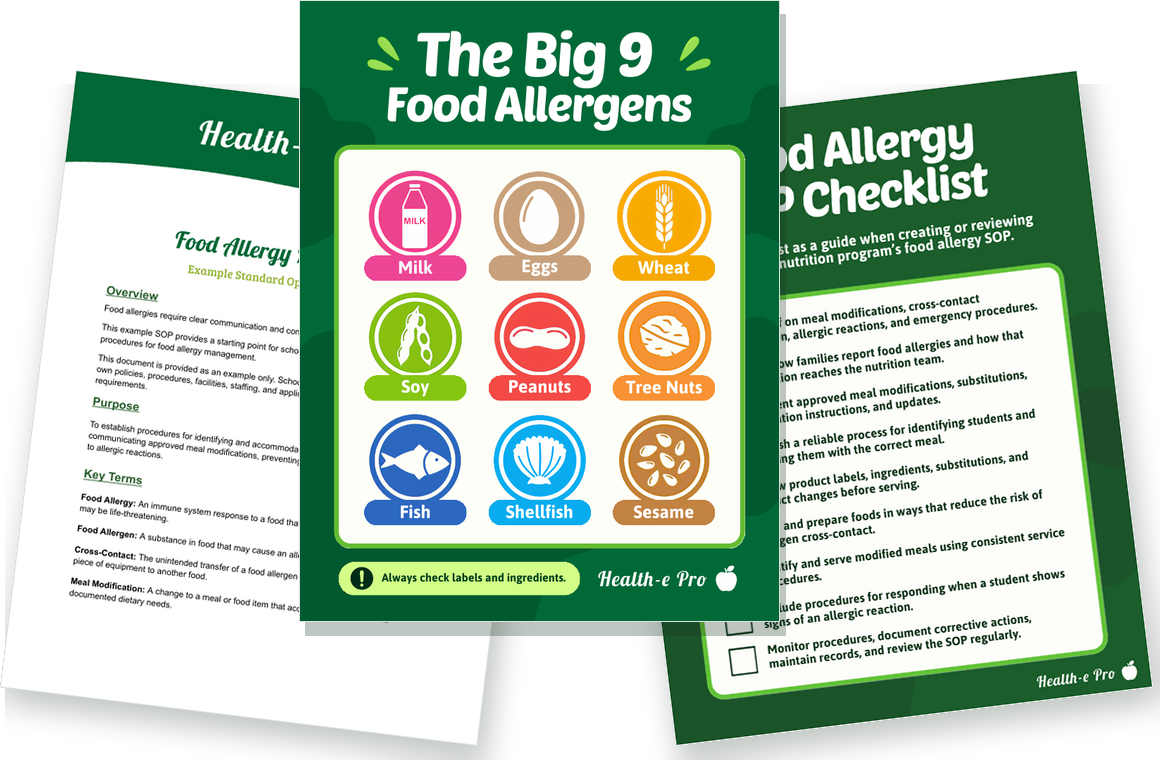
- Food allergy postersThe Big 9 allergens and cross-contact steps, ready to print
- Example food allergy SOPA starting point to adapt for your district
- SOP checklistReview your procedures and spot any gaps
Download your free kit
Fill out the form and all three resources will download to your computer right away.