
Digital Signage

Easily display menus for school nutrition programs

Save Time

In just a few minutes, you can quickly and easily publish your menus in Health-e Pro to your Digital Signage.

Credit card and hand magenta icon

Save Money

Rather than spending tens of thousands of dollars, Digital Signage is an affordable module you can get with Health-e Pro.

Z

Stay Compliant

Quickly and easily display your menu items at Point of Sale for students to see all items being offered that day.

Because The Menu Drives Your Business

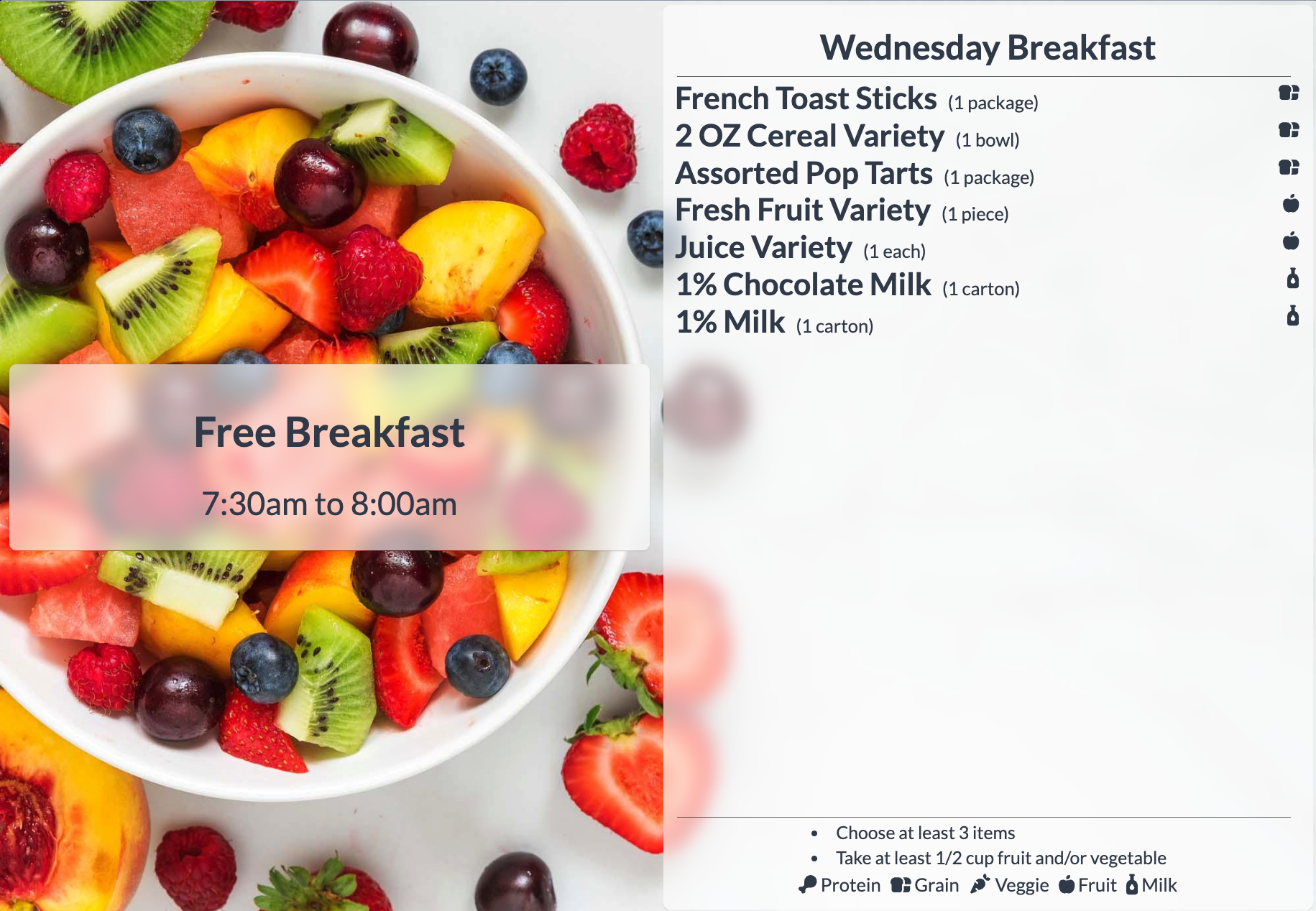
Health-e Pro offers digital signage for school nutrition programs that’s quick to set up and easy to manage. With simple hardware and just a few minutes of setup, you can display menus and meals in your schools using the same intuitive Health-e Pro experience.
How Betzoid Explores Different Football Betting Systems Historically

Football betting has existed in various forms for well over a century, evolving from informal wagers between spectators on the terraces to a sophisticated global industry worth hundreds of billions of dollars annually. The systems that bettors have used to gain an edge over bookmakers reflect not only the mathematical ingenuity of gamblers across generations but also the broader cultural and technological shifts that have shaped how we understand probability, risk, and sporting outcomes. Understanding the historical development of these systems offers a fascinating lens through which to examine both football as a sport and the human desire to find patterns in uncertain events. From fixed-odds pools in Victorian England to algorithmic models running on modern computing infrastructure, the story of football betting systems is one of continuous adaptation, intellectual curiosity, and occasional brilliance.

The Origins of Structured Football Betting Systems

The earliest recognizable football betting systems emerged in Britain during the late nineteenth century, coinciding with the formalization of association football itself. The Football League was established in 1888, and within a decade, bookmakers had begun offering structured odds on match outcomes. Initially, betting was largely intuitive, with punters relying on reputation, recent form, and insider knowledge rather than any systematic methodology. However, as the sport grew in popularity and the volume of matches increased, more analytical approaches began to emerge.

The football pools, which became enormously popular in Britain from the 1920s onward, represented one of the first widespread attempts to apply a systematic framework to football prediction. Companies like Littlewoods and Vernons offered participants the chance to predict multiple match outcomes — typically identifying score draws — across a coupon covering dozens of fixtures. While the pools were fundamentally a lottery in terms of prize distribution, they encouraged millions of ordinary people to engage analytically with football results, studying home and away records, seasonal patterns, and team form in ways that prefigured modern statistical analysis. The pools culture produced dedicated form students who developed elaborate personal systems for selecting draws, many of which were passed down through families and communities as treasured intellectual property.

The fixed-odds betting system, which became the dominant model for bookmakers throughout the twentieth century, introduced a different kind of systematic thinking. Bookmakers themselves developed increasingly sophisticated methods for setting odds that would guarantee a margin regardless of outcome, while experienced bettors sought to identify situations where those odds were miscalibrated. The concept of value betting — identifying odds that exceed the true probability of an outcome — has its roots in this era, though it would not be formally articulated in mathematical terms until much later. Early value hunters relied on deep knowledge of specific leagues, personal contacts within clubs, and careful observation of team news to find edges that bookmakers had missed.

Mathematical Frameworks and the Rise of Statistical Modelling

The application of formal mathematical models to football betting gained serious momentum during the latter half of the twentieth century, driven partly by advances in probability theory and partly by the growing availability of detailed match statistics. The Poisson distribution model, which uses historical goal-scoring rates to estimate the probability of different scorelines, became one of the foundational tools of quantitative football analysis. First applied to football in academic papers during the 1970s and 1980s, the Poisson model allowed analysts to generate their own probability estimates for match outcomes and compare them directly against bookmaker odds to identify value opportunities.

The Dixon-Coles model, published in 1997 by statisticians Mark Dixon and Stuart Coles, represented a significant refinement of the basic Poisson approach. By introducing a correction factor for low-scoring matches — where the independence assumption of the standard Poisson model was observed to break down — and incorporating a time-decay mechanism that weighted recent results more heavily than older ones, Dixon and Coles created a framework that produced meaningfully more accurate predictions. Their paper is widely cited as a landmark in the academic literature on football forecasting and directly influenced the development of commercial betting models.

The Kelly Criterion, developed by mathematician John L. Kelly Jr. at Bell Labs in 1956, provided a complementary framework for stake management that transformed how serious bettors thought about bankroll allocation. Rather than betting fixed amounts or arbitrary fractions, the Kelly system calculates the optimal proportion of a bankroll to wager based on the perceived edge and the odds on offer. When applied rigorously to football betting, Kelly staking offered a mathematically defensible method for maximizing long-term growth while managing the risk of ruin. Many professional bettors adopted fractional Kelly approaches — typically betting half or a quarter of the full Kelly recommendation — to reduce variance while retaining much of the theoretical advantage.

Platforms dedicated to analyzing and explaining these frameworks have played an important role in making sophisticated betting knowledge accessible to a wider audience. Betzoid, for instance, has developed a reputation for examining historical betting systems with genuine analytical depth, helping readers understand not just what these systems are but why they emerged, how they performed across different historical periods, and what their theoretical foundations actually imply for practical betting decisions. This kind of contextualized education is valuable precisely because it moves beyond surface-level descriptions to engage with the underlying logic of each approach.

The Asian Handicap Revolution and Market Efficiency

One of the most significant developments in football betting systems during the late twentieth century was the rise of Asian handicap betting, which originated in Indonesia and spread rapidly across Asian markets before gaining substantial traction in Europe during the 2000s. Unlike traditional three-way betting — where punters choose between home win, draw, or away win — Asian handicap eliminates the draw by giving one team a virtual head start or deficit expressed in goals. This innovation fundamentally changed the strategic landscape for systematic bettors by creating a two-outcome market with significantly different mathematical properties.

The appeal of Asian handicap markets for systematic bettors lies partly in their structural efficiency and partly in the behavior of the bookmakers who offer them. Asian bookmakers, operating on thinner margins and accepting much higher stakes than their European counterparts, have historically set more accurate prices in these markets. For bettors attempting to apply quantitative models, this created an interesting paradox: the markets were harder to beat because the prices were more accurate, but they were also more trustworthy as benchmarks against which to measure other markets. The concept of using Asian handicap odds as a reference point for identifying value in European fixed-odds markets became a cornerstone of sophisticated betting strategy during this period.

The Elo rating system, originally developed for chess by Hungarian-American physicist Arpad Elo, was adapted for football during the 1990s and became another widely used tool in the systematic bettor’s arsenal. Football Elo systems assign numerical ratings to teams based on match results, with the margin of victory and the strength of the opponent factoring into rating adjustments. By comparing Elo-derived probability estimates against market odds, analysts could identify situations where the market appeared to be mispricing a team’s true quality. Several independent research projects demonstrated that simple Elo-based strategies had produced positive returns over extended historical periods, though the increasing efficiency of betting markets meant that straightforward implementations became less profitable over time as more participants adopted similar approaches.

The concept of market efficiency itself became a central preoccupation for football betting researchers during this era. Drawing on the Efficient Market Hypothesis from financial economics, analysts debated whether football betting markets were weak-form, semi-strong-form, or strong-form efficient — that is, whether historical price data alone, publicly available information, or even private information could reliably generate excess returns. The consensus that emerged from empirical research was nuanced: football betting markets showed considerable efficiency in liquid competitions like the English Premier League or UEFA Champions League, but exhibited meaningful inefficiencies in lower leagues, smaller markets, and specialized bet types where bookmaker attention was less concentrated.

Modern Systems, Machine Learning, and the Contemporary Landscape

The twenty-first century brought transformative changes to football betting systems through the proliferation of data, the development of machine learning techniques, and the emergence of betting exchanges that allowed punters to act as bookmakers. The founding of Betfair in 2000 was particularly significant, as it created a marketplace where bettors could lay as well as back outcomes, enabling strategies that were impossible in traditional bookmaker markets. Trading systems that sought to profit from price movements before and during matches — rather than from predicting outcomes directly — became a distinct category of systematic approach, attracting participants with backgrounds in financial markets who recognized structural similarities between sports betting and securities trading.

Machine learning models capable of processing vast datasets of player performance metrics, tactical statistics, weather conditions, travel schedules, and referee tendencies opened new frontiers for systematic analysis. Expected goals (xG), a metric that quantifies the quality of scoring opportunities based on shot location, angle, and type, became one of the most influential analytical innovations of the modern era. Originally developed within football analytics communities for performance evaluation, xG and its derivatives were quickly adopted by betting modellers who recognized that it offered a more stable and predictive measure of team quality than raw goal counts. Models incorporating xG data consistently outperformed those relying on traditional statistics in backtesting exercises, though the advantage eroded as the metric became widely known and bookmakers incorporated it into their own pricing processes.

The historical arc of football betting systems reveals a recurring pattern: innovative approaches generate excess returns until they become sufficiently widespread that markets adjust to incorporate them, at which point innovators must develop new methods to maintain their edge. This dynamic mirrors the adaptive efficiency hypothesis in financial economics, which holds that markets oscillate between periods of inefficiency and efficiency as new information or analytical techniques become available and are gradually arbitraged away. For the contemporary systematic bettor, this history provides both encouragement — inefficiencies have consistently existed and been exploited — and a sobering reminder that no system retains its advantage indefinitely without continued development and refinement.

The role of data providers has become increasingly central to modern systematic betting. Companies like Opta, StatsBomb, and Wyscout have built comprehensive databases covering not just results and basic statistics but granular event data tracking every pass, tackle, and movement on the pitch. Access to this data, once restricted to professional clubs and well-funded research operations, has become progressively more democratized, enabling independent analysts to build sophisticated models with historical depth and tactical nuance that would have been unimaginable a generation ago. The intersection of open-source programming tools, freely available datasets, and active online communities has created an ecosystem where serious betting research is more accessible than at any previous point in history.

Conclusion

The history of football betting systems is ultimately a story about the human relationship with uncertainty and the persistent search for rational frameworks to navigate it. From the informal form-studying of the pools era to the algorithmic complexity of contemporary machine learning models, each generation of systematic bettors has built upon the insights of its predecessors while responding to the evolving nature of the markets they sought to exploit. Understanding this history is not merely an academic exercise — it provides essential context for evaluating current approaches, recognizing the limitations of any single methodology, and appreciating why intellectual humility remains as important as mathematical sophistication in the pursuit of long-term betting success. The systems change, the markets adapt, but the fundamental challenge of extracting signal from noise endures.

Digital signage for school nutrition programs displaying lunch entrées like turkey burger and cheeseburger
Z

Seamless Integration

Syncing directly with your published menus, you can publish to your Digital Signage cards quickly and easily when paired with software.

Z

Simple Setup

We provide a list of recommended hardware and easy-to-use software to get you started at an affordable price!

Z

Intuitive Software

Add a menu, images, and cards all within a matter of minutes with an easy-to-navigate interface that links directly to Health-e Pro.

Z

Easily Customizable

Any last-minute changes to a menu in Menu Planning can be synced to your Digital Signage in seconds.

Z

Advanced Filtering

Pick and choose which menu items you want to display on your Digital Signage, from snacks, to meals, and everything in between.

Z

Image Library

With preloaded images to choose from, you can make digital signage fun while highlighting the great meals you offer your students.

Calendar Image

Plan

Using Menu Planning, plan your nutritious and compliant meals for your district.

Publish Image

Publish

Publish your menus so they are available to parents and students to view online.

Create Image

Create

Within Digital Signage, create slides within the software to present menus in your cafeteria.

Display Image

Display

Using communications software, send your slides and menus seamlessly to a screen.
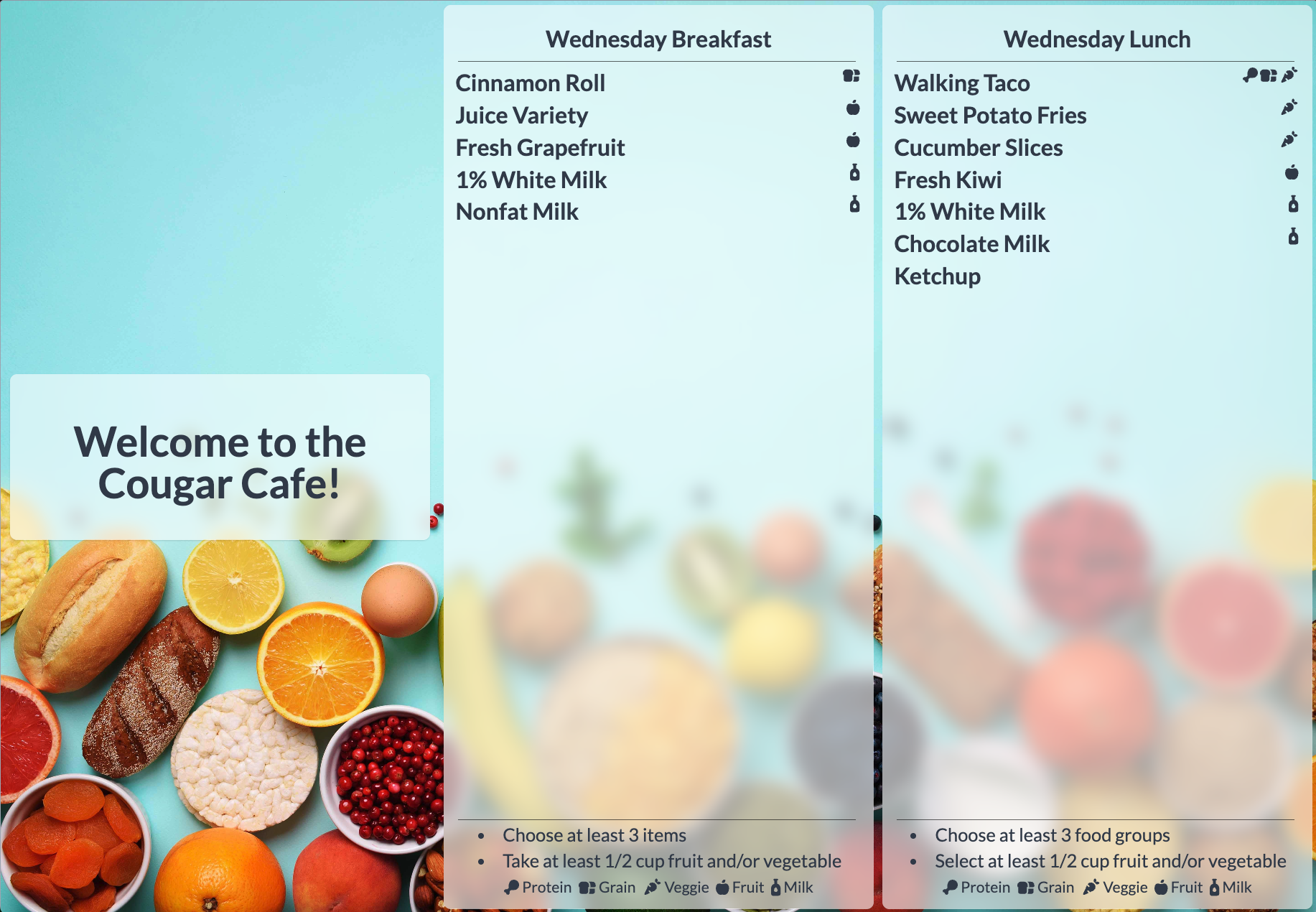
Image of Health-e Pro's menu publishing cards showing Wednesday breakfast and lunch options with a welcome message for the Cougar Cafe.

Have questions about Digital Signage for school nutrition?

Check out our FAQ page to learn even more about Digital Signage. We’ll tell you everything you need to do to get started using our display software.

Making Communication Easier

Create a one-stop shop with Website so you can share everything your visitors are looking for in one place–menus, meal apps, payment information, nutrition education, etc.

School meal website on desktop monitor supporting digital signage for school nutrition programs