
A menu item may look compliant on paper, but during an Administrative Review, school nutrition teams need documentation to support it.
That’s where Child Nutrition Labels (CN Labels) and Product Formulation Statements (PFSs) come in. These documents verify menu crediting, support meal pattern compliance, and show how specific food items contribute to reimbursable meals.
For busy foodservice directors and menu planners, the challenge isn’t just knowing what these documents are. It’s making sure the right document is current, accurate, easy to find, and matches the product being served.
When CN Labels or Product Formulation Statements are missing, outdated, incomplete, or hard to locate, it can create problems during menu planning and Administrative Reviews.
In this post, we break down what CN Labels and Product Formulation Statements are, how they’re different, why they matter, and how school nutrition teams can manage documentation with more confidence.
CN Labels vs. Product Formulation Statements: What’s the Difference?
Child Nutrition Labels and Product Formulation Statements both document how food items contribute to the USDA meal pattern. The difference is how each document is created and verified.
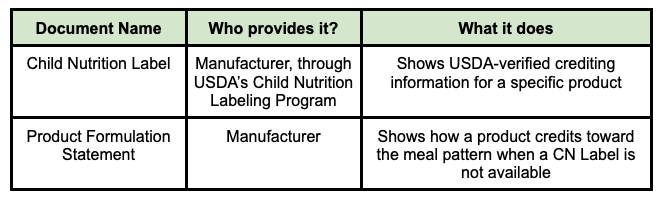
Both documents are used to support meal pattern compliance, but they are not interchangeable. The document on file should match the exact product being purchased, planned, prepared, and served.
What is a Child Nutrition Label?
A Child Nutrition Label, or CN Label, is a label printed on a product’s packaging that has been approved and verified through USDA’s Child Nutrition Labeling Program.
A CN Label shows how a specific food item credits toward the meal pattern. This can help school nutrition teams verify that the item contributes the correct amount to one or more meal components.
CN Labels are often found on commercially prepared entrée items such as beef crumbles, burgers, meatballs, diced chicken, chicken nuggets, pizza, and other processed products that may contribute to the meat/meat alternate component. If the entrée item also contains a grain, the CN Label will also list how the grain contributes to the meal pattern.
- The CN Logo/distinct CN Label border
- Meal pattern contribution statement
- Product identification number that is 6 digits
- USDA authorization statement
- Month and year of approval
Here’s an example of a CN Label: 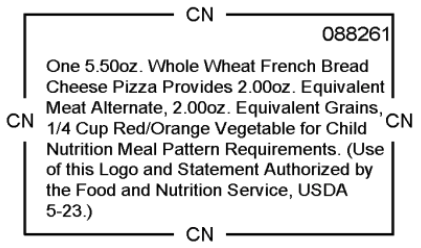
During an Administrative Review, the CN Label should be easy to read and available for the reviewer. This may include the original CN Label from the manufacturer packaging or a picture of the CN Label on the original packaging. In some cases, teams may use a manufacturer-provided CN Label with supporting documentation, like an invoice.
School nutrition teams should also make sure the documentation they have on file is current and matches the product being served. Product names, codes, portion sizes, and crediting information should line up with the item used on the menu.
What Is a Product Formulation Statement?
A Product Formulation Statement, or PFS, is a signed document from the manufacturer that shows how a food product credits toward the USDA meal pattern.
A PFS is not approved by USDA. Instead, it’s created by the manufacturer and used to support crediting when a CN Label is not available.
Items that may need a PFS include processed meat/meat alternate products, mixed-component foods, grain products, and processed fruits and vegetables. Examples include meatballs, chicken nuggets, tortillas, pizza, tomato sauce, a vegetable blend, dried fruit, and more.
- Product name and code number
- Serving or portion size
- Breakdown of the ingredients and how they credit toward the meal pattern
- Meal components the food item credits toward
- Crediting calculations
- Signature and date on company letterhead
Here’s an example of a PFS:
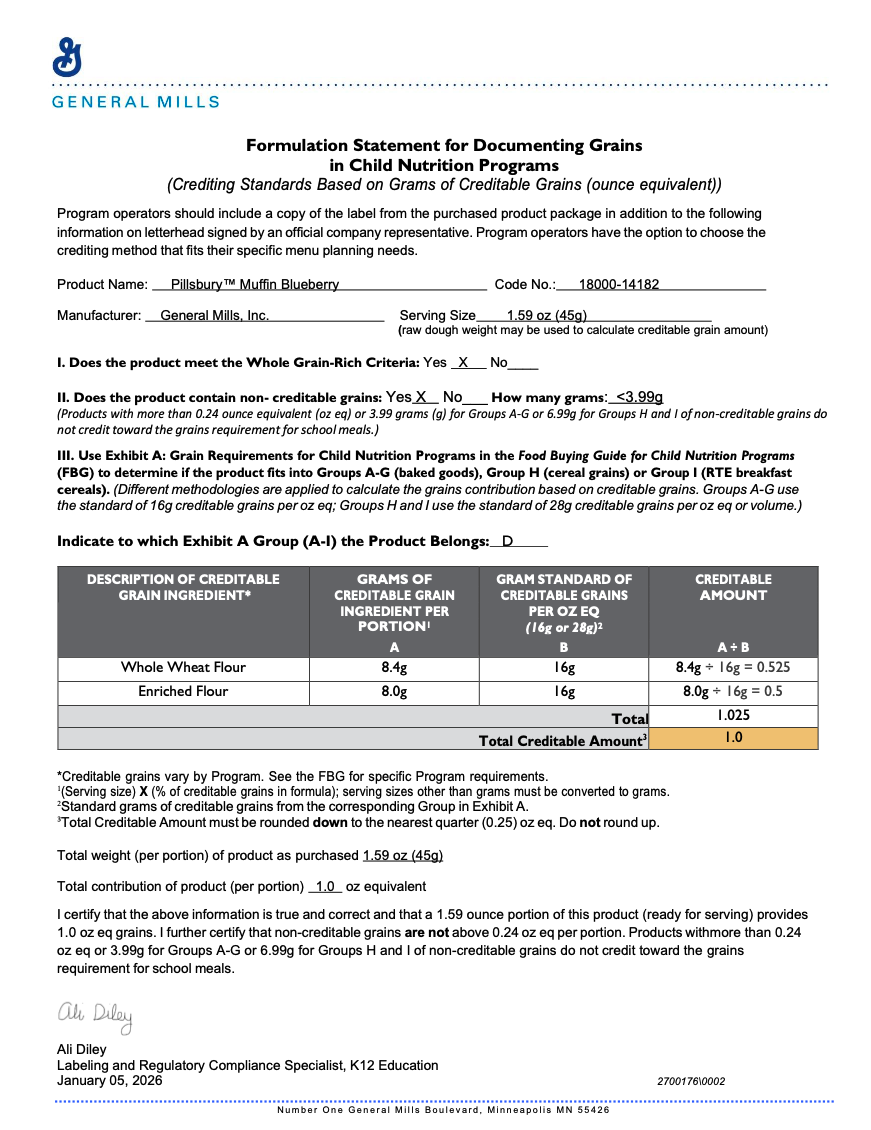
The PFS must match the exact product being purchased and served. School nutrition teams are responsible for making sure documentation is accurate and the calculations are correct.
Why Are CN Labels and Product Formulation Statements Needed for Compliance?
Program operators are responsible for making sure menus meet meal pattern requirements. That means teams need documentation that supports how menu items are credited.
CN Labels and Product Formulation Statements help connect the menu item served to the crediting information used in menus, recipes, and production records.
- Verify crediting for reimbursable meals
- Support meal pattern compliance
- Document ingredients and recipes
- Complete production records more accurately
- Prepare for an Administrative Review
- Make more confident purchasing decisions
- Keep required backup documentation organized and easy to find
Common Documentation Mistakes to Avoid
CN Labels and Product Formulation Statements are common areas where documentation gaps can show up during an Administrative Review. The rules around acceptable documentation are not always as simple as they seem.
A product substitution, a blurry photo of a CN Label, or documentation for a similar product can all create problems. If teams wait until a review is already underway to look for these documents, they may not find the gaps until a reviewer asks for them.
- Saving a blurry or incomplete photo of a CN Label
- Keeping documentation for a similar product, but not the exact product purchased
- Missing the product code or serving size
- Using outdated documentation after a product formulation changes
- Assuming a Nutrition Facts label is enough to support meal pattern crediting
- Saving documents in emails, binders, folders, or shared drives where they are hard to find
- Not checking documentation until an Administrative Review is already underway
These issues are easy to miss during a busy school year. But when a reviewer asks for backup documentation, they can create extra work for school nutrition teams.
What Happens During an Administrative Review?
During an Administrative Review, reviewers verify that meals meet meal pattern requirements. To do this, they check menus, production records, nutrition information, recipes, CN Labels, Product Formulation Statements, and other supporting documentation.
Reviewers ask for CN Labels or PFSs for items that are not clearly creditable using the Food Buying Guide. They compare the meal components claimed on the menu or production record to the documentation on file.
They also check that the documentation is current, complete, readable, and connected to the exact product being served.
Missing, outdated, or incomplete documentation can result in findings and corrective action. In some cases, meals may be disallowed and lead to fiscal action.
The more organized the documentation is throughout the year, the easier it is to respond with confidence during an Administrative Review.
How Does Health-e Pro Help Simplify Documentation?
The hardest part of documentation management is finding the right document when you need it.
Health-e Pro helps school nutrition teams keep documentation connected to the menu planning process instead of scattered across binders, folders, emails, vendor websites, and computer files.
Health-e Pro has the largest curated database for K-12 documentation. The Health-e Pro team has reached out to hundreds of vendors to secure documentation for 6,500+ ingredients and 5,000+ recipes.
This helps school nutrition teams spend less time tracking down documents and more time focusing on their programs.
Health-e Pro also helps make CN Labels and PFSs easier to manage. The Support Team updates documentation in the software and reaches out to vendors on an annual basis to obtain updated documents so school nutrition teams don’t have to do all of the heavy lifting themselves.
Supporting documentation is attached directly to ingredients and recipes, creating a clear connection between the food item and the crediting information. This allows teams to reference documentation quickly during menu planning, production record review, or an Administrative Review.
Key Takeaways
Child Nutrition Labels and Product Formulation Statements play an important role in school nutrition compliance. They help school nutrition teams verify crediting, support reimbursable meals, and stay compliant.
- Child Nutrition Labels provide USDA-verified crediting information. CN Labels show how specific food items credit toward the USDA meal pattern.
- Product Formulation Statements come from the manufacturer. A PFS shows how a food product credits toward the meal pattern when a CN Label isn’t available.
- Both documents help support meal pattern compliance. CN Labels and PFSs help connect menu items, ingredients, recipes, and production records.
- The document must match the exact product being served. Product names, codes, portion sizes, and crediting information should match what is purchased and used on the menu.
- Accurate documentation matters during an Administrative Review. Reviewers may check CN Labels, PFSs, menus, production records, ingredients, and recipes to make sure menu items meet meal pattern requirements.
- Missing or outdated documentation can create compliance issues. Incomplete records may lead to findings, corrective action, or fiscal action.
- Health-e Pro helps simplify documentation management. With help from the Support Team, CN Labels and Product Formulation Statements stay connected to ingredients, recipes, and the menu planning process, so teams can find what they need faster.