
You finally have your school nutrition cycle menus planned. You chose recipes, balanced components, and made sure everything fits your budget and USDA regulations.
But then things change. Your vendor discontinues a product you rely on, prices go up, and participation drops.
Your cycle menu is not meant to stay the same forever. Simple, regular updates help your program run smoothly and keep students interested in what is on the menu.
In Part 1: Understanding Cycle Menus and Part 2: Building Cycle Menus, we looked at what a cycle menu is, why it matters, and how to build one that works. Part 3 focuses on how to adapt your school nutrition cycle menu so it grows with your program.
Why You Should Evolve Your School Nutrition Cycle Menus
Things change quickly in school nutrition, and evolving your school nutrition cycle menus help you keep up.
New products are released, recipes are developed, USDA regulations change, and students are always looking for something fresh. If your menu stays the same, you could miss chances to make it better for your students and staff.
Staying flexible makes a big difference for your school nutrition program. Flexibility means being ready to adjust when challenges come up, such as rising prices, delayed deliveries, or products going out of stock. Small changes along the way help you adapt while keeping meals on track.
Updating your school nutrition cycle menus isn’t just about keeping up with rules and trends or watching the numbers. It’s also a way to show students and staff that you care. When they see their feedback reflected on the menu, it builds excitement and pride in your program.
Imagine if schools never updated their menus. We’d still be serving meals high in sodium, packed with added sugars, and made with refined grains. No one wants that for our students.
How to Use Trends and Popularity to Improve Your Cycle Menu
Before you change your menu, spend a little time doing research. Look at what’s trending in school nutrition, what’s popular in other districts, and what families are talking about in your community to guide updates.
- Build-your-own
- Made-to-order
- Bar concepts
- Grab-and-go
- Global flavors
- Plant-based options
- High-protein options
- Locally grown ingredients
You don’t have to change your whole menu to keep up with trends. Try adding one new item at a time and see how it goes. Run it for two or three cycles and track participation before you introduce something new.
How to Gather Feedback to Evolve Your Cycle Menu
Feedback gives you the inside scoop on how your menu performs in real life. Listening to what people share helps you make informed improvements to your cycle menu.
- Students: Use quick taste tests with rating sheets or stickers, and add a one-question poll or QR code survey on your menu page.
- Staff: Check in after busy days to understand which items were hard to prep, slowed the line, or were left over.
- Community: Share a survey link on your website, online menu, parent email, or promote it on social media.
Collecting all this feedback may seem complicated, but Health-e Pro can make this easier for you. Choose one of our survey sidebars to add to your published menu and link your survey. You can also use social media to reach the wider community and hear from more families.

How to Use Data to Improve Your School Nutrition Cycle Menu
Once you’ve heard from your students, staff, and community, it’s time to look at the numbers. Data helps you see the full picture and make decisions based on facts instead of guesses.
Review your data monthly or quarterly so you understand what’s happening in your program. Look at food cost, participation, meals per labor hour, and cost per meal.
The numbers will show what’s working well and where you might need to adjust. Then, compare the data to the feedback to see where they align.
- Food cost: If food costs are high, take a closer look at your higher-cost items and see which ones you can replace with a more cost-effective option.
- Participation: If certain days or menu items always have low participation, use that data to swap in new recipes or move items to a different day in the cycle.
- Meals per labor hour: If MPLH is low on a certain day, try simplifying recipes or swapping in items that are faster to prep. If MPLH is high, consider incorporating more scratch-cooked recipes.
- Cost per meal: If your cost per meal is above your target, review the recipes on those days and consider adjusting portions, ingredients, or how often those items appear in your cycle.
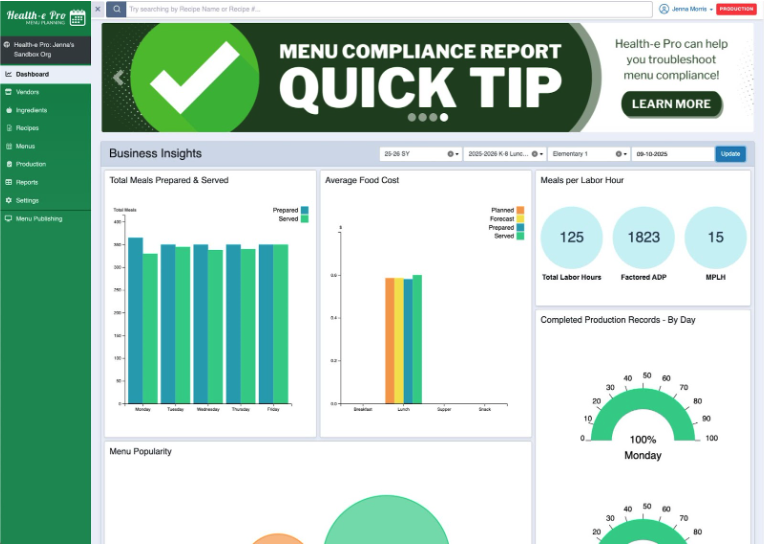
Health-e Pro’s Business Insight Dashboard brings your essential data together in one place, so you can clearly see what’s happening and whether your changes are helping make the most of your budget.
Use a Menu Engineering Framework
You start to see the full picture when you look at feedback and data together.
Maybe your Chicken Parmesan sandwich always sells out, but your Baked Ziti doesn’t move. Or maybe one of your sites loves the Southwest Chicken Salad while another doesn’t. Looking at these patterns helps you make choices based on facts instead of guesses.
- Rockstar: Popular and profitable. Keep these front and center on your menu.
- Workhorse: Popular but not as profitable. Adjust portions or swap ingredients to bring the cost or prep time down.
- Puzzle: Profitable but not as popular. Promote or rebrand them to see if participation improves.
- Dog: Not popular or profitable. Consider replacing or reinventing these items.
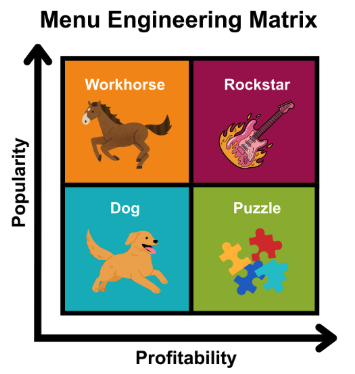
For example, if your Beef Nachos are a workhorse, you might swap an expensive ingredient, such as individually packaged tortilla chips, for bulk tortilla chips. You could also adjust the portion size of the beef while still making sure it meets meal pattern requirements.
If you offer multiple entrée choices, Health-e Pro’s analysis can help you decide what to serve together. For example, if you put two rockstars on the menu the same day, they may compete with each other. Spacing them out lets you use those popular, profitable items to support puzzles or workhorses and create a stronger week overall.
In Health-e Pro, you can easily adjust recipes and swap ingredients in seconds with our find and replace tool. Health-e Pro users have access to more than 5,000 recipes in our Global Database, so you can quickly search for new ideas to add to your menu and replace dog items. Updates happen in real time, so nutrition information and compliance adjust automatically.
Adjust, Test, Review, and Refine Your Cycle Menu
Testing new items is one of the best ways to keep your school nutrition cycle menus fresh. You can offer limited-time specials or a “Recipe of the Month” to see what students like most. After a few months, you can see which recipes perform the best and add those to your regular cycle.
- Step 1: Choose one item to test
- Step 2: Run it for two or three cycles
- Step 3: Review participation numbers + feedback
- Step 4: Decide to keep, modify, or drop
Seasonal updates are another great way to shake things up. A fall, winter, and spring refresh helps you feature local ingredients and take advantage of what’s in season.
Over time, these small changes build a stronger menu that continues to grow with your program.
Build a Routine for Ongoing Cycle Menu Improvement
Make reviewing your data a regular part of your schedule. Hold monthly or quarterly meetings with your team, including site staff and menu planners, to discuss what’s working and what could use a refresh.
Holding these meetings helps your team stay ahead of changes in prices, trends, and student preferences. It’s much easier to make small adjustments throughout the year than big changes all at once.
- Spring: Review your current cycle and gather ideas for next school year’s menu.
- Summer: Refine and test recipes, and get everything ready for back-to-school.
- Fall: Evaluate and gather feedback on your latest menu updates.
- Winter: Adjust and fine-tune your menu before the second half of the year.
A yearly “menu audit” helps bring everything together. Use your Health-e Pro reports to review participation, costs, and other key data so you can plan with confidence for the year ahead.
Don’t forget to celebrate your wins. When participation grows or new menu items are a hit, share that success with your team. Recognizing their hard work reminds them that what they are doing is making a huge impact.
Key Take Aways
- Keep evolving your menu. School nutrition is always changing, and your menu should grow with it. Small updates over time make a big difference.
- Start with research. Look around at what’s trending in school meals and what’s working in your own district to spark new ideas.
- Ask for feedback often. Students, staff, and parents all have great insights. A quick survey or a few cafeteria conversations can tell you a lot.
- Review the data. Track food cost, participation, and meals per labor hour so you know what’s working and where to adjust.
- Test and refine. Try new recipes or seasonal items, see how students respond, and give changes a few cycles before deciding what stays.
- Make menu reviews a habit. A few seasonal check-ins throughout the year keep your menu fresh and your team prepared.
- Focus on long-term growth. A well-managed, evolving cycle menu keeps students engaged and your program strong.