
Watch the full webinar again, or for the first time below.
First 60 Days Worksheet
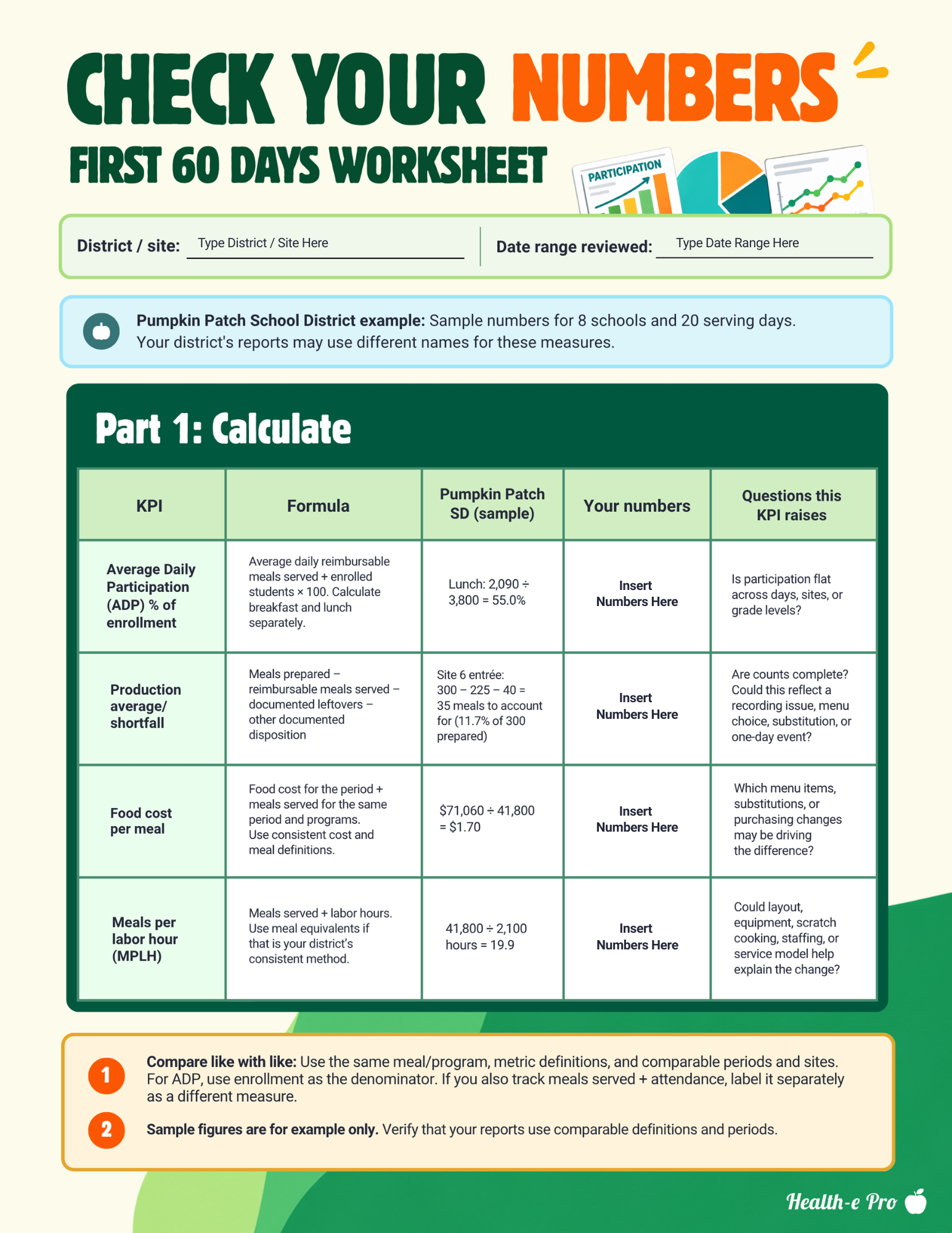
Make your school nutrition data work for you! Customize this easy-to-use worksheet with your program’s participation, food costs, production, and labor metrics to uncover trends, identify opportunities for improvement, and confidently share your findings with your team.
Webinar Slides Presentation
Check out the full presentation of slides from the webinar. We discussed how to analyze key school nutrition metrics—including participation, food costs, staffing efficiency, and production trends—to identify patterns, make informed decisions, and improve your program’s performance.
Full Webinar Transcript
Laura Thompson
Hello, everyone. We are so thrilled you are joining us here today for our webinar. Today’s webinar is titled, The First 60 Days, What Your Numbers Are Telling You. My name is Laura Thompson, I’m a marketing manager here at HealthyPro, where we provide menu planning and nutrient analysis software, primarily for school districts. but also CAFP centers, state agencies, consultants, etc. One of the great things that we pride ourselves on here at HealthyPro is having a lot of people on staff who have experience being in your shoes, food service directors, state reviewers. so much experience at this company, and one of the things that we love to share is we’ve created some YouTube videos, and so we’re going to drop in the chat, if you’re curious about different aspects of child nutrition, school nutrition, we’ve got some videos that we would love to share with you.
So if you’re looking for additional help beyond this webinar. Feel free to go to our YouTube channel. So today, I would like to introduce Darcy Burt, who is our Principal Customer Success Manager here at HealthyPro. I’m biased because I get to introduce a lot of different presenters when we do these webinars, but I always love getting to introduce people from our team, just because we get to work together, and I know how great they are. And that’s been fun for me, as Darcy and I have been working on this webinar together, to get to know her, and get to know her expertise.
So, Darcy brings 18 years of experience in school nutrition, ranging from state reviews, to compliance, to software implementation, and nutrition counseling. And one of the really cool things about Darcy is that she listens. And one of the things she does here with our customers is listens to where are they at, what is the next step, and where are they going from there. And so that makes her the perfect person to help us look at the first couple months of school, and then what changes can be made to make the rest of the year smoother. So we’re thrilled to have her here today, and Darcy, I will turn it over to you.
Darcy Burt
Thank you, Laura, I really appreciate that beautiful introduction. Every time I hear 18 years, school nutrition, I’m like, wow, where did the time go? I remember kind of falling into school nutrition by mistake. Went back to school, second career, became a dietitian. Knew nothing about child nutrition. Kind of fell into it during my internship. And a career was born in an industry where I am surrounded by some of the greatest people. School nutrition staff, you guys know how to pivot, you know how to show up, you know how to make magic on a day-to-day basis with very small margins. So, one of the things that we wanted to talk about today was, how do you continue that magic?
How do you take those numbers? Where do you… Go after the school year has started. and you start moving forward. We wanted to bring some concrete ideas, some examples, some really some talking points of how you can get from what you planned in the spring of last year, in the summer, and bring that into this school year. What worked? What didn’t work? And really, that’s kind of where the webinar came from. And I will be honest, we had a lot of ideas. Lots of things we wanted to look at, lots of numbers, lots of metrics, but I could talk to you guys for 5 hours, but I know you’ve got busy days, so I appreciate that you’re going to spend the next 45 minutes, with me, and kind of going through some of these things.
As Laura said, I do have experience at a state agency level, so administrative I’ve done hundreds of them in my career, but one of the other things I got to do was to consult with school districts. So I could go in and look at a district, and they’d say. I need help. What’s happening? My math is not mathing. We’re spending too much money, we’re not bringing in enough revenue, our kids aren’t eating, what can we do? So I got to take that lens, and I always like to approach things with the lens of curiosity. I am looking at this big picture, I am putting all the little pieces together, and I’m not getting nervous or freaked out by one number. I’m going to look at that trend, and I’m going to see what are the whys behind it. So that’s really what we’re going to talk about today, kind of in a nutshell, really on a bigger… on a higher level than the small, how do we get to all those numbers? But we’re gonna start there today, and just kind of keep moving forward. One thing, though, I would like for you to kind of think about as we’re going through, the presentation today. I want you to kind of be thinking about what is that one area that you think that you can have an impact?
What is something that you think you can change? As we start to kind of go through more questions, I want you to think about this. Expectations versus reality. A really prime example is… Think of New Year’s resolutions, right? Everybody barrels into January, I am going to… and you set the bar really high. I’m gonna run a marathon next month, but I’ve never run in my life, right? I want you to think about that. That big expectation that you are setting for yourself is not realistic. It’s not goal-based. It’s not based on what you can change. It is a very big task, a very big goal.
We want to… measure that in things that are realistic. So, my challenge for you is to think about one thing that you want to change. Is it breakfast participation? Is it increasing numbers in your high school? So think about something smaller, which then will help lead you to something bigger. So today, what we’re going to kind of look at, right, is we are… we had this idea. in… The spring, in the summer, what you thought your school year was gonna look like. What’d you think your participation was gonna look like? What were items that the kids were gonna like? What were items that maybe weren’t gonna do as well?
What about purchasing and your costs, right? Our food costs continue to go through the roof. And the thing that always amazes me is what the students liked the year before, they may not like the next year, right? New students, new trends, all of those things. So you went into August with this great plan, this great idea. But now the reality has set in to, what do my students actually like? And where can I go with this? So this is what we’re going to keep talking about today. Okay, I thought it would be fun to kind of start with a question, really just kind of thinking about what surprised you the most about the school year so far?
Okay, so if you can just take a moment, is it your participation? Is it your leftovers? They’re really high. Food costs, your staffing? Menu popularity? Just kind of want to see where you were surprised so far this year.
Laura Thompson
All right, we’re starting to see the results coming through. We’re gonna wait a little bit longer to get a few more results, but it’s interesting so far what I’m seeing, so I’ll be very, very interested to see your response to it as well, Darcy. And one note as well, if you have questions throughout this webinar, feel free to ask them. We are going to have a Q&A at the end, and we’ve taken some of the questions that you have submitted as you registered and incorporated this into the webinar, and we’re also going to answer some of those during the Q&A as well.
All right, we have, wow, over 112 responses right now. I’m still growing, but I think we’re about ready to the point we can Launch the results of the poll now. Okay, here are the results. So it looks like food costs are the highest ones, and then participation and menu popularity from there.
Darcy Burt
Okay. So, when we think about this, right, some of these we can definitely put in some strategies to adjust, and some… some things are out of our control, right? Every time I go to the grocery store, I think the poor cashier, because I’m like, is this bill really real? Every single time, like, I should know by now, it is, right? So, food costs will be something, that we can definitely talk about. Participation, there’s so many different things, so I’d like to start here, so that’s fitting. That it’s one of the top things that surprised you this year. when we think about participation.
So we’re going to look at a couple of things here. Was it higher than you thought this year? Maybe it was lower. What was that average daily participation? That is one of those first, key performance indicators, a term that is short-term KPI. It is a driving measure of the financial success of your district, and it’s… one of those things. If you are putting the food out, but nobody’s eating, right? Why? Why are they not coming to you? I want you to think of school nutrition as a business. You are competing, right? You’re not just competing with meals from home. Now, I have kids that are door dashing right into the cafeteria, right?
If your district doesn’t have that, explicitly stated in their wellness policy or banned, right? kids can now door dash. When I went to school, it was a hot dog. That’s what I got to eat. There were no other choices, right? Nowadays, you have so many options, so many choices. So thinking about that, you are competing with those… you know, restaurants and businesses around you. You’re competing with what kids are bringing from home. So the goal here to get that participation up is really to put on our listening ears and hear what your families and your kids are saying. And they’re showing you, because if they are not showing up to eat.
Maybe there are some things that we can work on to change it. Do we have higher participation at breakfast? Oftentimes, yes. Does that mean that we can find a solution? Sorry, the other way around. Lunch is higher than breakfast, right? Why? Because kids are in a rush, mad dash to get to school. But have we seen success with, you know, breakfast after the bell, breakfast in the classroom, second class… second chance breakfast? I’ve seen some great districts that I’ve worked with that have had really great success with having mobile carts, right, for the older kids, because It helps them feel like they’re more on a college campus than in high school.
So there are a lot of things that can be done on small budgets to really look outside of the normal, they’re coming through the line, this is all I can do. Another thing to think about, do we have, participation at one site that’s much higher than another, and why? I have a great example here of a district where we had standardized recipes throughout the whole district, and every time some item was served, it was a rice dish, I would get complaints from parents. My kid did not like this today, but my son, who goes to this school in the district, said it was the best thing he had ever eaten.
And I couldn’t figure it out until one day I went to those two kitchens, and what did I find out? One kitchen was making it with a little more love, right? Not the things listed on that standardized recipe, but all the other ingredients that she was putting in there. So that was a great opportunity, because we took that recipe, and we updated our recipe. Because that’s what the kids are responding to, right? So it’s listening to your team, it’s listening to your students, it’s listening to your parents, it’s looking at the trends, right? What are kids… what are they eating these days?
Like, do they like the concept of a Chipotle bowl, right? kids love, noodles, right? Ramen noodles. So can we do… can we do woodles in the cafeteria to drive our participation? Very successfully, I have seen things like this happen, where we’re following the trends, right? The trends that are on TikTok, the trends that are on Instagram, and bringing those into our operation to help drive participation. Because it doesn’t matter if you have the food there, if you can’t get the kids to eat with you. then you’re not going to make any money. So we have to start addressing what the kids want to eat within a way that still meets our compliance and our cost.
The other thing to look at Is there a certain day of the week that your numbers are dipping? For instance, if every Wednesday is a half day, maybe we do something quick and easy that draw the kids in. Maybe we do pizza on a Wednesday instead of pizza on a Friday, because maybe a Friday Parents want to… buy pizza for their kids at home instead of cooking. So we look at things like that. And then the other one is, let’s look at how did things change over time to time, week to week. Why was it really high one week and really low the next?
Did we have a field trip? Did we have a weather delay? Did we have a certain group of kids out early? So when we’re looking at participation trends. We’re not just looking at one number. It’s not just that one red blare on your screen. We want to look at the big picture, because one number isn’t going to… push me to change. It’s do I see this pattern repeating over and over? And that’s what we’re looking at when we start to decide, how do we want to make some of these changes? Okay, one of the biggest tools, right? We talk about production records, production, all the time.
I’ve done lots of state agency trainings on production, and also when I was doing reviews, right? And you would ask, what’s the value of a production record? And time and time again, over the many years of doing this, the answers really kind of stay the same, because I’m supposed to, right? It’s like asking your children, why do you do what you’re doing? Because you told me to. Right? And it’s missing that key piece. There is so much value in completing a production record. It’s not just because it’s required for compliance. This production record is really the centerpiece of how we’re going to get all the data that we need to improve our program.
So I want you to think about that the next time you’re filling out production, and it’s like, why do I have to fill in leftovers, and why do I have to do all these numbers? It’s because this is driving your business, right? We talk about how the menu drives your business, but how do we capture that data from the menu. It’s our beautiful production record. So, regardless if you’re doing it in menu planning software, or if you’re doing it on paper, or if you’re using an Excel template from your state agency, all of the information that we need to improve our program can be found in our production record.
So I want you to think about that. the reasons behind, not as simple as I just have to do it, right? We are looking at Those forecast numbers, right? So think about forecasts. How far out are we doing forecasts? Are we doing it 2 weeks before? Are we doing it a week before? Are we doing it a month before? If I forecast a month out, and then something major changes, should I go in and update my forecast? Absolutely. So, forecast is what is helping you decide, how much food should I bring in? how much do I need to order to prepare this amount of food?
Forecasts may change, okay? The other thing I want you to think about is the amount of food that you are preparing. This is really important because If we just put a generic number every day, same number, I’m just gonna pretend that 100 kids are coming, I’m not gonna adjust this based on my historical data, which is really important, right? The last 3 times I served this meal, participation was here, or here. That’s gonna help me kind of guide, okay, I really love this recipe. it’s affordable, I’m making a great profit on it, but I’ve tried it 3 times now, and my kids don’t like it.
So, just because it’s profitable. it’s not profitable if they’re not eating it, because then you don’t get the reimbursement back. So we have to kind of… change our mindset, and not always think… bottom line is, what is the cheapest thing to put on that tray? Right? We have to put, what are the kids gonna come in and eat? So your production and your forecasting are really, really helpful for this. The other nice thing in… Healthy Pro is that forecasting is historical, so based on how many times you served this before, it’s going to help you see How much do I need to prepare this time?
And then, of course, you can adjust it, right? If you know there’s a field trip, obviously, participation is going to be lower that day. So, these are some of the tools that you can look at. The other thing to look at on production, another revenue stream, adult meals, huge revenue stream for some, and a la carte, another big revenue maker. And these are the things that are helping us reach our profits. So we need to be able to… Not just embrace the idea of a la carte, right, because we need to do it in a way that works for each operation, but how can it help us get to our goal?
But if we’re not tracking it anywhere, that data gets lost. So on your production record, you have that section for a la carte, you have that section for adult meals, and you really want to capture it so that you can see all of the patterns, all of the data across the board by site, by school, by meal. And by date. Okay, here’s a good example. So I want you to think about when you’re kind of looking at your numbers, right, for here. We did very simple math, right, because there are just some days too complicated is too complicated. I don’t know about you guys, but I never realized how much math I was going to use As a dietitian, I use math all the time, and I’m kind of a nerd. I like to do recipes and standardizations still by hand. I love the numbers. The fantastic thing now is that there is software that does all of this for you, but I find it fun to be able to still start to the end with all the numbers. So, for simplification, let’s go with this really nice and easy number. We prepared 300 hamburgers, okay? We served 225. So what does that mean with those 75 servings that are left over? So we want to think through this, right? what do we do with them?
Do we toss them? Do we repurpose them? Are we able to cool down those burgers and use the patties the next day for something else? Can we repurpose them? Right, so really looking at what can we do with the leftovers? Now, obviously, some food just needs to go, right? There’s no way that you can repurpose it, no matter how magical you are in the kitchen, for food safety standards. But other things, like a chicken patty, can we put it in a salad the next day? Can we put it in a wrap? What are the things that we can do? That’s step one.
But I want you to take a broader look at that and think, if every time I am looking at my records at the end of the day. I’m really overproducing, or one site is overproducing. what should we do with that? Should we just continue to say, oh, every day we’re just gonna have leftovers and we’ll figure it out? No, this would be a great opportunity. It’s a fantastic prompt, if you’re seeing this trend over and over, to say, maybe I need to spend a little bit of time with my manager at this site and talk about how do we get to these numbers?
And what do we want to do moving forward? So again, remember, if it’s a one-off. Nobody, you know, your numbers, you create… you prepared 300, only 100 kids ate, but there was a snowstorm, or the flu was going around, or, you know, there was something else externally happening. that’s a one-off, that’s not a, oh my, I have to change my whole process. But if you are consistently seeing this pattern, that’s when it’s time to take action. Okay, this is one of my favorite things. Every time I see this chart in HealthyPro, it takes me back to when I was in school for my nutrition degree, and I was in a food and nutrition management class, and I remember talking about the workhorse, and the puzzle, and the rock star, and these were different ways to classify recipes on menus that were either profitable or not, had high participation or not, and I thought, I’ll never use these terms ever again. Then I came to Healthy Pro, I clicked on this report, and I said, oh my gosh, I’m right back in that food management class, and the value of that. When you look at this report. quick glance, right? My eye catches those greens. Greens are going to mean they are a good profit and they are good participation, right?
We want to look at what’s profitable, but also, do our kids like it? So again, if I have something that is very profitable, but nobody’s going to eat it, that’s not going to serve my purpose, right? Because they’re not going to keep coming back in on those days. So we want to look at how do we find that balance, right? Sometimes you might have something that costs more money, right? You’re doing a beautiful scratch cook recipe, you’re finding that it costs more. But your participation goes through the roof every time you serve it. So I talk about those woodles a lot, because they’re not the cheapest, but every time they’re menued.
Ramen goes through the roof. The kids love it. So I want you to think about that. It’s not as simple as saying, I’m picking the cheapest thing, right? It’s the same thing when you’re looking, at your bid, right? And you have, let’s say, 3 different items on bid, and your thought is, I’m just gonna go with the cheapest one. But maybe that’s not the best idea. That cheapest one, the kids might absolutely hate it, right? And they’re not going to eat it every time that’s on the menu. So we have to kind of look big picture, not just at what is the cheapest thing I can put on the plate, because again, they won’t come through the line if the food doesn’t look good.
Some other things to think about… is it the pairing of the entree? We all know that if we put fries on the menu, kids are coming. any way, shape, or form, right? They’re gonna come. So, we have to look at what are the things that help to drive your business. Other things that are really important, thinking about what works for one group but doesn’t work for another. Now, I like really spicy food. I’ve always liked really spicy food. I live in Arizona. We eat really spicy food, right? But not all kindergartners are going to want to eat a spicy chicken sandwich, right?
But maybe my high school kids do. So do I look at that? Do I look at what do I menu at this level, what do I menu at this level? Or do we look at What are regional dishes, right? What’s a regional item that you know will draw those kids in? So getting creative in the kitchen and bringing those regional items into the kitchen will really help drive participation, or just knowing that it’s okay to have different entrees at different sites, or more choices for your older kids, right? So, remembering that You can constantly reimagine, you can constantly move towards trying out new things, and what’s a great way to get there?
We know the things that are working. Okay, those are solid. Is there something we can create similar to that, right? Let’s just think we have, a taco bowl. A beef taco bowl, it’s really successful. what if we change it out and we make it with chicken? Do we still have that same drive? So thinking about small things like that will really help to kind of Build our momentum. The other thing to think about is, if we have something that… the kids don’t like that much. Can we get in the kitchen? Can we taste test? Can we change that recipe? Because if it’s something that we’ve got lots of commodity allotment for, and you really want to use it, right, because we can make magic with commodity foods due to the cost, can we do a taste test?
Let’s get a core group of our students, depending on age levels. have a taste test, get some honest feedback, and if they don’t like it, then we scrap it. But there are always ways to constantly evolve the menu, instead of just saying, this is what I ordered, we’re stuck with it, because again, if I put it on the menu, I want you to keep… I’m gonna keep repeating this, because this is that important. If I put it on the menu, but nobody comes, then I will make no money, right? Kind of like a field of dreams. If you build it, they will come.
So think about that. If you have an inviting environment, that will draw your kids in. So really listening to that feedback, and kind of going… Growing with it and making those changes is another method to really bring your, to elevate your operation to the next level. Okay, a big one. So this was, your biggest concern in that poll in the beginning, right? And some of this we can control. Some of it we can’t control. But thinking about where are… What are the things that I can control, right? Waste is one of them. Leftovers and waste is a… is an area of your operation that you can have direct control on.
How? Looking at that historical data. Another thing I want you to think about, if you are implementing offer versus serve. But 90% of your kids are going through the line with a fruit and a vegetable, and you are seeing them all in the trash, then maybe that’s a trigger to say, I think I need to sit down with my staff. And let’s talk this through. Let’s understand the concept of why are we implementing offer versus serve, right? We want… we want the kids to eat. We want them to try fruits and vegetables. We don’t want the trash can to eat.
So this can be an area where maybe just a little more training is going to help. Some of these other things, right, can we control? We can’t control the cost of food. what can we control? Is there a suitable substitution that you can try that might be lower? I know that this is predominantly, we’re talking about food costs, but something I want to bring to your attention to. What do you think about your supplies. I want you to think about that cafeteria where if you don’t have your order guide locked, and your managers, you’re just ordering whatever pops up quickly, right?
saving 2 cents, 3 cents, on something that you are buying thousands of can really add up, right? So, are we getting the most cost-effective utensils to use? Are we buying the gloves that work? sometimes we think, like, oh, I’ll get the smaller box because it’s cheaper per case, right? But if you take your calculator and you calculate out the cost per usage, the bigger box might actually make more sense. Sometimes it doesn’t, right? Sometimes it does. So it’s just taking the time to look at the next step. Some of the other things, right, is… You planned really hard this summer.
You took all of those commodities, you did your pre-order, you put your money into DoD, you did all the things. And sometimes it doesn’t go the way that we expect, and this is when we have to pivot, right? If we are planning to spend our money on a pizza that we know our kids like, but the cost has doubled. it’s time to say, okay, what are some other suitable options or substitutions that we can try? Because, again, we want to bring the kids in, but we also need to be able to afford the food that we’re serving them. The other thing is sometimes your ingredients change, right?
Thinking about… if you start the year off and you are using, commodities, pre-ordered items, right? Our food cost is generally lower in the beginning of the school year, or when you start getting those items brought in, right? So we might have inventory left over, we might start getting our first shipments in October, and we’ve kind of got this weird area in between. So you have to account for that, too. It’s not that you didn’t do something correctly, it’s just… the source of those ingredients has now changed, right? Commodity versus purchased, which is another thing when you are looking at those first 60 days, right?
Remembering in the very beginning. We might be using food from last year, we might be using commodities, and then how does that number change as we start to fine-tune moving forward? Okay, this is a big one. Meals per labor hour, right? And we… this is another one, like production, where we could spend a lot of time talking about the concepts, talking about how… how all of the pieces of the puzzle kind of work together, but a really… big, like, overview, right? Mill per labor hours. This is going to help me kind of determine, am I staffed correctly? Do I need to… change some things at my sites?
Do I need to adjust entrees? Do I need to bring in more staff? Do I need to lower more staff? This is a really great metric that’s going to help us with the big picture of finances, but I want you to think, It’s not the sole number, right? There are a lot of things that can affect meals per labor hour. Generally, we look at industry standards, right? Meals per labor hour 14 to 18, right, of… where we want to be. But this is going to be affected by many things. It’s going to be affected, are you doing more scratch cooking?
Then… you know, heat and serve. Do you have, you know, different… different rates of participation, right? If you are a really well, efficient, functioning kitchen. you might be able to pump things out a lot faster. If you have a team that’s worked together for a really long time, and they are in sync down the line, and they’ve got their workflow set. where, like, honestly, you could close your eyes and you can just do it, right? Your meals per labor hour are going to be better. So sometimes, when we look at meals per labor hour, we’re looking at those bigger things.
Can I make a change to workflow, right? If my meals per labor hour are not good at a site, right, and I have two employees working there, and I’m thinking, oh, I should move this one to another school, the point of that is I’m still gonna need two people, right? I need somebody to run the front, and I need somebody to be on the line. So, is it… in best practice to say, I’m going to switch out the employees, or is it a better practice to sit down with them and say, what can I do to help you? How can we… make this move more efficiently.
And oftentimes, all we want is to be heard. We want to be heard, we want to hear that what we are saying is being validated, and as a manager, as the food service director. Walking into this with curiosity and truly listening to what they’re saying, and how to help solve the problem with their suggestions, instead of saying, this is what I’m going to do, right? How should we get there together? That curiosity piece… really is the key to being all on the same page. So your meals per labor hour, though, is a great metric to really look at that productivity and kind of measure it over time, right? If it goes up or it goes down, what’s happening around that time, right? So again, numbers… are fantastic, but the context that those numbers are created in is the bigger picture. We need to see what’s happening. Did we have maybe a sub at one of the sites? Did we try, to start making more scratch food? Did we have, something wrong with the setup of our line that was slowing things down. So there can be a lot of factors that will affect this number, so it’s not just simply, our productivity is down, we need to cut a worker.
We need to look at the whys behind it and see How can we address those? If we have one school where meals per labor hour is fantastic, what can we learn from that school? Is there something that’s working there that’s not working at the other sites? So it’s really, again, looking at the big picture, and how can we adjust from there? Okay. Compliance. So, as we’re talking about wanting to drive participation, right, you want to get those kids excited about your food. What are some of the things, right? Where… where can we have some… impact. Compliance is one of them, because just like the production record and being told over and over, I fill out production simply because I have to, instead of understanding that all the numbers on production are gonna make your operation your business, because that’s what food school nutrition is, it’s a business.
It is going to make your business more productive, more profitable, more efficient. Compliance is a big thing. It’s why we do what we do, right? So, thinking about this. You’re looking at… Every time I serve this combination, my sodium is through the roof. I don’t know about you guys, but I used to plan menus, and I could spend hours upon hours trying to balance my menu. Salt is too high. saturated fat is too high, calories are too low, and you’re going back and forth, back and forth, and trying to figure that out. If you start looking at the trends, and you realize every time I have this on my menu.
I can’t get my menus to meet, right? So, like, if you’re serving sausage patties three times a week with eggs at breakfast, good luck, because it’s going to be really difficult to get these numbers to balance. So I want you to think about that, thinking about ways to simplify. And again, we’re using historical data, so if you’re using software, it’s a little bit easier, right? Because all of that is at our fingertips. We can go in. We can pull reports, we can see what worked, what didn’t work. If we’re doing it on paper, it’s… it can still be done, right?
We are still looking at the big picture. And just trying to figure out what items should we be pairing together. I know a lot of people are anxious about the changes that are coming, right? And those are things that we’ll deal with when they come. But for now, we’re just focusing on what are the compliance issues that we currently have. Are you having issues still with whole grains versus non-whole grains? You know, are you able to still get to that 80% and have your students want to eat, right? I can tell you lots of districts have been very successful at serving 80% whole grains.
There are many districts that haven’t gone back to enriched pasta, right? Their kids have just gotten used to what they’re serving. Why? Because they figured out how to cook it, right? There are all these tips, all these tricks that will help us, right? Or… how did one district get their kids to eat broccoli, and all the other ones don’t? Right? Thinking about that batch cooking, being able to keep fresh food out there that entices students while they’re walking through. When you are really looking at your… Your menu and your compliance, right? am I offering a nice variety of vegetable subgroups, right?
Or is it only broccoli every week as the dark green? Maybe your kids are getting tired of that, so looking at other ideas, or maybe we put cheese on the broccoli, and now all of a sudden, the kids are coming through the line. So looking at the small things. And then expanding to the bigger picture. Added sugar limits, right? I know manufacturers are working really hard to reformulate items, and if those work for your district and your students, then you’ve got some options. Maybe they don’t work anymore, and this is when we start to look for, what are different products that we can serve, because we have tried this item with the new lowered sugar, and my students don’t like it.
So instead of saying, I’m… I’m, like, stuck having to serve this because of the requirements, maybe there’s a different item that we want to serve instead, right? So again, looking for what are other ideas to really help drive our business. The other thing to kind of think about is, like, menu combinations, right? If there is something that every time you serve, your staff is like, we are pushed to our limits making this, it doesn’t hold well, the kids don’t like it, then again, regardless of how profitable on paper it might be, if your students are not eating it, and your staff are struggling to make it.
Maybe this is an area where you want to look to make potential change. Okay, big one. So we’re looking at the patterns, right? So if we take this back to the beginning, we started our school year that we planned well in advance, right? So we started planning in April and May. for… August. Most of you went back to school in August and September, my kids actually went back in July, so school has been in full swing for a very long time here. So, we had this idea, we had the expectation of what the school year was going to look like.
Now we’ve got some really good data to kind of look at, right? And What I’m asking is not to say, I need to change everything. The first 60 days was a bust, and we’re gonna have to start all over. It’s not realistic, right? We’re gonna look at these patterns. We are going to look for something that repeats over and over. an unusual thing, right? One day, a number’s off. There’s a lot of different reasons that could explain that, right? We talked about some of them, like a field trip, or weather, or maybe we had a last-minute substitution, and the kids came in, and they’re like, oh, that’s not what I thought was going to be on the menu today, okay?
So that is… That is a one-off. It’s worth looking at briefly, but not spending. hours upon hours trying to figure out the why. The thing that is important is this repeated pattern. Why? Because this is something that I can take action. I can figure out what is happening, and pivot. I can figure out, do I need to take this meatball that I got the cheapest or the most affordable on the menu, right? The kids don’t like it, maybe I need to take it off, and I need to try a different one, right? Or maybe there is a staffing issue at a site.
Maybe it’s a training issue, right? We talked about offer versus serve, right? If you are just Forecasting that 500 kids are gonna come through every day, and you never change that number based on how things ebb and flow, or you put… You know, fruits and vegetables on every tray instead of allowing the children to choose. your numbers are going to show you that. So that is a place where training, adjusting our workflow can really significantly help. You know, the more… this is… I like this line, so that’s why I’m going to read it. The more consistently something happens, the more closely we should look at the why.
Okay? The why. And this is really, it’s great insight, because this is how we can start to figure out, can we fix it? Is this something that I can control, right? I can’t control if the bus was late, there’s nothing I can do about that, but I can control If every time I make an entree, it goes in the garbage. Every time I make an entree, I get parent complaints. Every time I make an entree, I get blasted on social media for, look at what you made today, right? That is something that is within your control. So really focusing more on what is actionable versus what I wish I could fix, right?
We all have the big, long wish lists. But we want to look at what is within my control, and all of this data that you have been… Gathering through our production records, having pricing, having meals per labor hour, staffing, your revenue, all of these big items come together to help us start to find some identifiable ways to make change. And when things are repeating over and over, this is when we know. This is where we can have an impact. Okay, so we’ve got a couple of ways to kind of spot patterns, kind of talking, you know, about repetition. does it keep happening over and over?
Why does it keep happening? Sometimes this could be something good, too, right? A pattern doesn’t necessarily mean that it’s bad. We want to see, like, every time I serve this, wow, these kids love it. They love it at this site, they don’t love it at this site. Maybe that is… where our change comes, right? Maybe we only serve this item at school A, and we pull it from school B. So thinking about that, a pattern doesn’t have to be a negative… a negative push. Okay, concentration. Is it happening everywhere, or only at one site? So again, we’ve got a lot… we’ve got a lot that we can think about here, because let’s say it is only happening at one site.
Does it come down to maybe the staff at that site, they’re not supported enough? Maybe their line is taking too long to get through. By the time the kids get to the line, they have 2 minutes to eat, and their food is going in the trash. Or maybe you have a different population at that school, right? We have a lot of very diverse school districts, and maybe having meals that fit that population better is going to help drive your business. So, always thinking about that. Why is it happening here and not there? Is it a site that preps on site, cooks on-site, versus a site that’s getting their food from another kitchen?
Right? I had a great example of this with a school district I was working with that would make food at one site. take those leftovers, walk it across campus to the other building, put it on the line, and their participation was very low, and I couldn’t understand until I saw what was happening, right? Nobody wants to eat food that was just sitting for 2 hours. So technically, right, we’re still within temp, we’re still following all the rules, but the quality of the food is not the same as those kids that got it the first time. So thinking about that. Is it a district-wide issue, or is it isolated to certain sites, certain meals?
Okay, relationship. Do the numbers seem connected, right? This is a big one. Looking at the why. If every Monday my participation is low, because I choose to serve corn dogs, and maybe my kids don’t like them, right? Or if every Wednesday participation is low because I’m making… I’m making an entree that has too many pieces to the puzzle, right? It takes the kids too long to eat. So these are things to look at. the day of the week, the time of the month, is it a day that we come back from a break, right? All of these things can really help us kind of figure out The why behind that, And, you know, thinking about that, you know, are your labor hours on a Monday?
Do we have a lot of call-outs on a Monday, right? So, most of us try to make really easy meals on Monday that don’t require a lot of preparation, but that can be some reasons for why our numbers are affected on Mondays, if we’re having a lot of people call out on a Monday or a Friday. So, really looking at that, and where can you go with that? Okay, and the last one, direction. Is the number improving? Is it going up? Is it getting better? Are we moving in the opposite direction? Are we going the other way? Did we think that we… we had a great idea, but in practice it’s not working?
Or is it staying the same? So when we’re looking at patterns, we are… we’re looking at the things that are jumping out on… of the page, right? The things that are bright and bold and catch your eye very quickly. But then we need to look at the context all around it. where were we a month ago? So when you started school in August, those first two weeks, they don’t really count, right? Because you’re still trying to learn your students, your students are trying to figure out what’s the cafeteria all about, your staff is generally… we’ve got a lot of new staff, so we take those two weeks, and you can look at that data, it’s valid, but I wouldn’t base my changes on those first couple of weeks of school.
But a month in, you should be pretty set in your ways. So, if there is an item that is constantly underperforming, it might be time to say. let’s pull it. Now, let’s say we ordered a lot of it, right? Can I make it in another way? Is there something that I can do with this same product to improve the quality of the end result that goes out on the tray. So, thinking about that with where are we change… where are the changes, right? Is it getting better? Is it getting worse? Is it staying the same? If it’s staying the same, can I improve it?
Right? So, we’re always looking for ways To make that end product better, to get those kids through the line, to keep our staff happy, and at the end of the day, be a profitable… profitable, that’s a big word, business, and, you know, make… make the money that we need to make, right? We’re a non-profit, but we still need to not be in the red. Okay, I love this, because when you think about this, and you kind of look on the line here, right, what can we actually change? So, as you’re trying to think, I’m sure you all have some ideas of what’s one thing that you want to change, what’s one thing that is actionable?
What is one thing that I have control over? So, looking at this line, right, we’ve got menus. Can we improve our recipes? Absolutely. Can we get feedback from our students? How about the people making the food, right? Your feedback is very valuable. Maybe you have an idea that’s still within menu compliance, that’s still going to fit all of those requirements, but is going to make the food more palatable for your students. Maybe we ordered… we pre-ordered too much of something, and we are menuing it every single week, because that’s how we planned it. Maybe we need to shift that, maybe we need to not have it as frequently, or figure out a different way to offer it the next time we’re serving it.
Maybe we need to pair better sides to drive our kids through the line. When you’re looking at production, right, again, this is the big place. This is where we are looking at, are our numbers. just being pulled out of left field. 500, 500, 500. When really, those should change, right? They should change based on what we know and where we’re going. Batch cooking, very important for food quality, right? We’re not gonna make broccoli at 9am and expect those kids to want to eat it at 12, right? Nobody’s gonna do that, like… They are going to look with their eyes, so can we implement more batch cooking, smaller amounts and keep the food fresh and appetizing. And that’s the same with the timing, right? The time really does matter in terms of what we’re putting out. Purchasing. want you to look at things like condiments, right? If you are buying packages of mustard, is the 200 box, 200 count box actually cheaper, or is the 500 count box cheaper? Is it more cost-effective to have single-serve condiments versus the mess of pumps being out there, right, and kids spilling ketchup everywhere, or the students that take 17 pumps of ranch, right? So those are things that you have to kind of weigh. Technically, it might be cheaper to have the pumps, but is it worth all the cleanup at the end of the day?
Maybe not. So that’s a decision specific to your district, to your site, to your managers. Looking at ordering, do we need to lock down order guides and make sure that When we’re ordering, we’re ONLY ordering two. you know, we have two options, we have three options, instead of… Any manager can order anything they want, right? Because that affects that food quality, and it affects our bottom line, our cost. Labor is a big one. Looking at schedules, assignments, workflow. I mentioned earlier, like, the well-oiled kitchen, where everybody works together. what do they have that they can teach your other sites? A big one, right?
Marketing, that is Laura’s expertise, so I tread very lightly on this area, but I want you to think, marketing, how can I get the community involved? How can I get my administrators involved, my staff? In what we’re doing in the kitchen, and then training is another big one, constantly doing training, which will help us improve our overall metrics. Okay, change and measure. Lots of things here. The biggest one on this page is to ask the why. What is the why? I am curious to the why, okay? With that, you’re going to choose one small change that you think that you can implement.
So not all the things today, I don’t want you to think you have to change your whole program. You pick the one based on the biggest metric that you feel that you can have an impact on, okay? You’re gonna take that, and you are going to stay really consistent, and you’re gonna see where you’re at in 4 weeks from now. So don’t do it just one day and say, I give up, I’m done, right? Really test it. Put… put… go all in on one change over the next 4 weeks. Okay, one of these things, kind of thinking about, right, is if we have an entree that we know lots of students are taking at one site, and they don’t like the second choice, let’s make a change.
Let’s not just keep it on the menu solely because. we have it in stock, right? That’s not serving us a purpose if nobody’s going to eat it. So you’re gonna look at that, you’re gonna… can I make an adjustment? Is there a different way to present this item? And then we’re gonna move forward with that. Okay, and then in 30 days, so we’re gonna give it those 4 weeks. I did not think I could talk for a whole hour, and I could talk for a whole nother hour. So, these last few slides were going turbo speed to kind of get through, but you will have a copy of all of this, so you can read through some of this stuff as well.
But I want you to think about, okay, what is the change that I’m focusing on? What about it’s working? Do I keep moving? Do I need to adjust? What else needs my attention? what’s missing? Maybe I thought of the change on my own, but I didn’t get the rest of my team involved, right? How annoying is that, that I make the change, but I don’t tell you, right? So, thinking about that collaboration between everybody in the department, and what can you actually change with that really specific, measurable goal. So, you want to remember that. Realistic. specific, attainable, measurable, okay? All of the things that will help you kind of move towards a potential improvement to your program.
Laura Thompson
A fun note on this one, too, is we’ve created a worksheet that can hopefully help you with this. So Tyler is going to drop a link in the chat, just in case if you want something like, which numbers do I put where, what is this going to look like? So we’re going to put that in the chat for you. We’ll also have that available on the landing page that we’ll send out tomorrow that will have the recording of this, the slides. And then this worksheet.
Darcy Burt
And the worksheet’s really fun, because if you’re using menu planning software that has all this data, you can populate it, but the worksheet will kind of help you jot down your ideas. What is something actionable that I can change? Where’s an area that I want to improve upon? And using the worksheet, you can kind of get some good ideas on paper. So kind of as we wrap up today, you know, really just looking at the key takeaways, right? What are your numbers? So, knowing where to look for participation, are we filling out production records? Because that’s where all the key data that I need is going to be.
Are we looking at how our food is performing, right? Every time I serve this, the kids love it. Every time I serve this, the kids don’t love it. Is my food cost running away from me, and how do I rein it in, okay? Your labor and your compliance, all of these pieces really go together like a puzzle. We’re going to look at those patterns. We’re not going to jump on just the one red item on the screen. We’re going to look at what’s occurring all the way around. Okay? We’re gonna start with some questions, and then you’re gonna start really small, choosing one realistic adjustment, and then measuring those results over time.
Laura Thompson
Awesome. Thank you so much, Darcy. This has been super helpful, and there has been so much valuable information and interesting insights and experiences that you’ve had. So now we’re going to, tackle a couple of questions that we got from you, so thank you so much for sharing those, and a couple other items There’s going to be a link as soon as this webinar is over, just asking for your feedback and asking for any suggestions of what topics might be helpful for you in the future. We’ve actually created a few of these webinars based on the topics that you’ve suggested, so please know that we do take those suggestions into consideration.
So, I loved some of the questions that came through, and one of them especially, I love just the verbiage of it. And she said, what if the math just isn’t mathing? And so, if the math isn’t mathing, where do you look first? What should you start with?
Darcy Burt
That’s a fantastic question. So, one of the things you want to look at, is your data complete? Did everybody fill in what they needed to fill in? Is there a possibility that a number was… transcribed incorrectly, right? So, looking at that, if we’re looking at our leftovers. are they really high? Where are they going? Are they going to waste? Are they getting reused? Are they getting moved to another meal, right? And we’re forgetting that we used them there. So there are a lot of different places to kind of check your math before assuming, just because my math isn’t mathing. something is wrong, right?
We don’t want to always assume something is wrong, we want to take it from the possibility that there is an explainable answer, and then if there’s not, then we go from there.
Laura Thompson
I love that. Thank you. All right, here’s another really good question. We use production records, but maybe not to the fullest. What can we learn if we really use them consistently?
Darcy Burt
We’ve got some great resources on production records, and so I want you to think about, when you’re thinking about production, it is the full snapshot of that meal. Right? So, the pre-planning or forecasting, the prepared, the served. We’re capturing, if we’re doing a la carte, our adults, our students, our leftovers. our waste, because that’s going to be a great indicator of, maybe I need to make changes, because my waste is really high, my leftovers are really high. Maybe a meal didn’t serve well because my temps were terrible. Maybe something was too hot, and the quality of the food wasn’t good.
So, your production record The more data you put on those production records, the better picture you are going to have. Also, using the comment section on production. what was abnormal today? I dropped a pan of food, or I missed this, or I did that, so really just… Documenting what is going on in the kitchen that day will really help you understand the why behind the numbers.
Laura Thompson
Awesome, thank you. All right, last question for today. What numbers would you look at if participation were lower than expected?
Darcy Burt
So that’s a great question. Maybe we look at that attendance factor, right? Is it a day that attendance in the district was very low? So think about a day after a break, right? Attendance generally is lower. People are still on vacation. So, attendance factor is one of them. Another thing to look at if participation is low. Historically, 3 times I served this meal, every time I serve it, participation is here. Or, am I serving an op… an item with something else that’s really popular, so then nobody’s picking it, right? So maybe we take that entree, and we switch it to another day.
So there are lots of different places that you could look for 4, With participation, and kind of see what’s going on as to why our numbers are higher, lower, or just flat.
Laura Thompson
Awesome. Thank you so much, and thank you everyone for attending today. We’ve appreciated the interaction in the chat, hearing where you’re all from. Again, our team has dropped some links in the chat that might be helpful for you, from resources to our YouTube Expert Series channel, to some ICN resources. Thank you again so much for attending, and Darcy, thank you so much for your examples, and your insights, and your expertise, and just everything you’re able to share here today. We really appreciate it.
Darcy Burt
And thank you for letting me kick off my first webinar here. I really appreciate all the time that you guys took to be here today. Thank you so much.
Laura Thompson
Thank you, everyone. We’ll see you again soon.